Grove: From Reading App to Inquiry System
A local-first system that helps a conversation carry evidence, annotations, and changing answers across time.
- My role
- Product direction, interaction model, and local-first architecture
- Question
- A library-shaped interface could store reading activity, but it could not make an ongoing question the center of the product.
- Topics
- AI interfaces · local-first · product design
Context
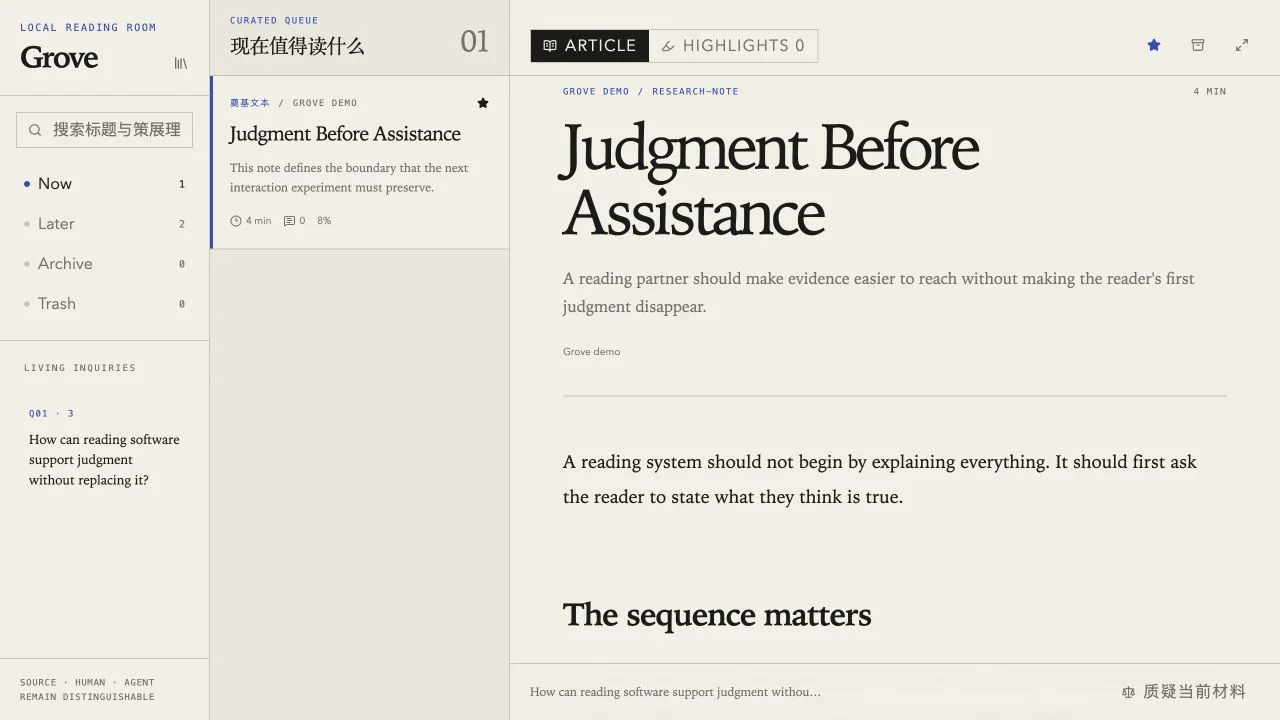
Grove began as a local-first reading room inside ChatGPT. The first prototype could import self-contained source documents, search and fetch them through local tools, and write back reading progress, highlights, stars, and annotations.
That prototype proved the technical foundation. It also exposed the wrong product assumption. A Library → Queue → Reader interface inside a conversational host was still a conventional website, only smaller. It duplicated navigation and synthesis that the conversation already handled well.
My responsibility
I owned the product correction: identify what the prototype had actually validated, separate those capabilities from its interface, and define a new interaction contract.
The work was not to add another screen. It was to decide which responsibilities belong to the conversation, which need deterministic local tools, which deserve a temporary visual surface, and which must survive as durable records.
Hard decision / tradeoff
The hardest decision was to retire the most visible part of the work—the reading app’s information architecture—without discarding the working system beneath it.
Keeping the app would have produced a clearer conventional product demo. Retiring it made the product less immediately familiar, but preserved the more important insight: the primary object is not an article. It is a continuing inquiry with a current answer, competing evidence, contradictions, revisions, and consequences.
Artifact
The work produced two distinct artifacts:
- A validated local reading-room prototype with canonical source records, local retrieval, durable reading state, highlights, annotations, and writeback.
- A product contract for an agent-native inquiry system in which ChatGPT remains the primary environment and Grove supplies evidence, provenance, deterministic operations, and the smallest sufficient visual surface for a specific turn.
The contract also defines the next bounded experiments: explaining why a source matters now, comparing conflicting evidence, and revising an answer with an explicit reason.
Evidence
- Canonical source documents remain usable independently of the interface.
- Reading state, highlights, and annotations survive across sessions through deterministic writeback.
- A full reading-room widget was built as a technical prototype.
- The current vision explicitly distinguishes source material, human annotation, and model interpretation.
- Durable changes to a person’s judgment require confirmation; clicks, dwell time, and highlights are not treated as beliefs.
What changed
The top-level object changed from a document to an inquiry. ChatGPT became the home of intent, dialogue, challenge, and synthesis. Grove became the local evidence and state layer, with focused visual canvases appearing only when comparison or direct manipulation adds value.
This also changed the success criterion. The system is no longer judged by how complete its embedded library feels. It is judged by whether a person can see why evidence matters, preserve their own judgment, and understand how an answer changed.
Current status
Active. The local evidence, canonical-record, retrieval, and writeback foundation is validated, and the first reading-room widget exists as a prototype. The inquiry-centered direction is now the product contract. The evidence-conflict and answer-revision experiences remain design experiments, not finished product capabilities.