Hao Lab: A Cyborg Living Experiment
A personal living laboratory that turns rooms and reused devices into a distributed interface for agent perception and action.
- My role
- Research framing, system architecture, interaction contracts, and end-to-end integration
- Question
- What changes when computer interaction extends from one screen into a living environment of local sensors, memory, and bounded device capabilities?
- Topics
- human-agent interaction · ambient computing · local-first systems
Context
Most AI products are bounded by one application or one special device. Hao Lab asks what changes when the environment itself becomes part of the interface.
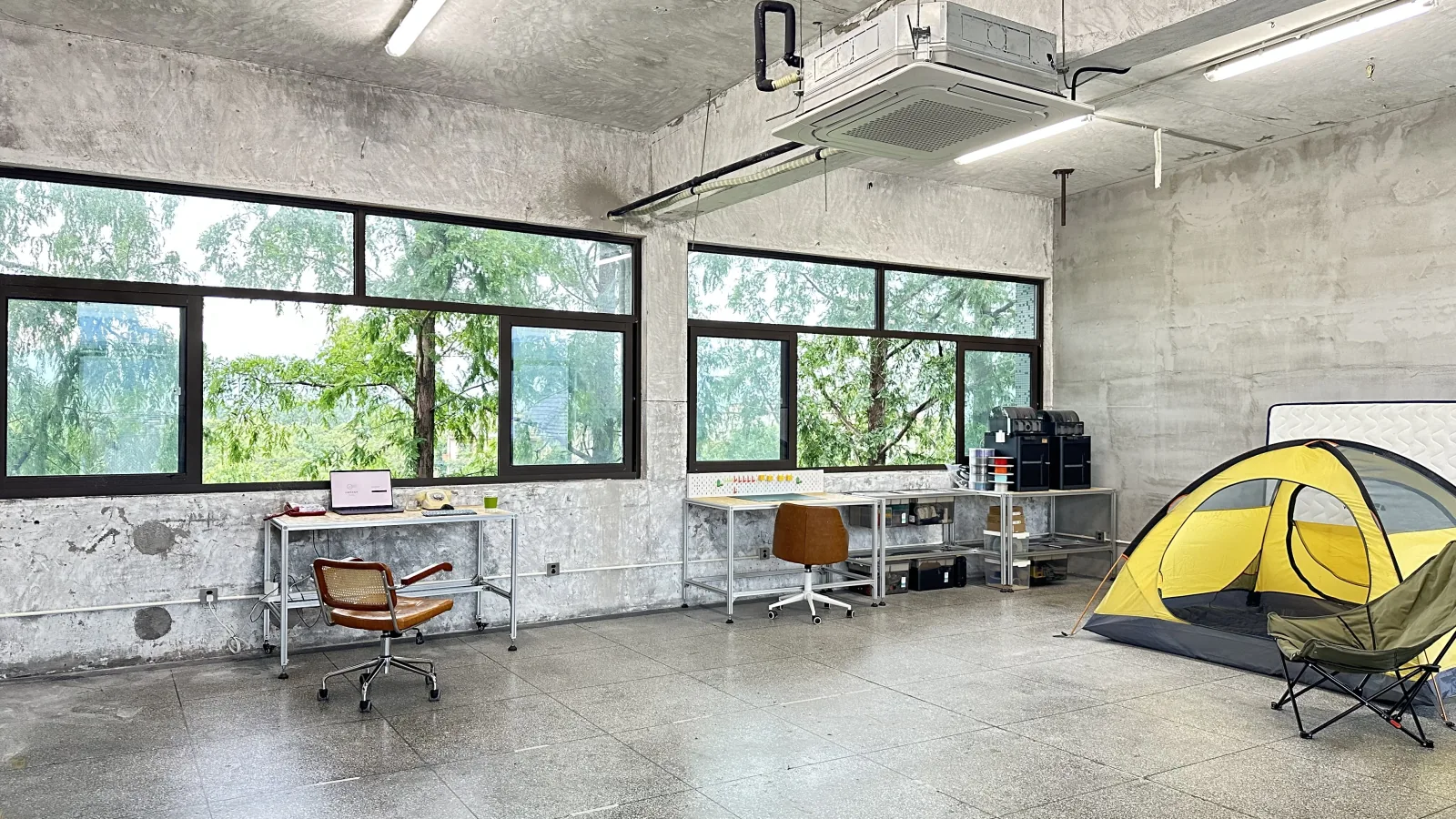
It began in a former classroom near Liangzhu and is now centered on a portable Mac that connects agent sessions, local memory, reused Android sensor nodes, personal media, and physical interfaces. I use “cyborg” here to mean a coupled system of person, agent, memory, and environment—not an implant or wearable.
The question is not how to automate a room. It is how a person and a thinking machine collaborate when perception and action are distributed across devices and physical space rather than contained in one application.
My responsibility
I defined the research frame, system architecture, and interaction contracts, then worked across the control plane, device nodes, local applications, and real-device validation to make the boundaries inspectable.
This is interface and systems research through prototypes. It is not frontier-model training, and the current system does not update model weights from experience.
Hard decision / tradeoff
Distributing perception across a living environment creates a systems tradeoff: more context can make an agent more capable while making the environment more invasive and harder to inspect. The implementation therefore keeps perception, retention, and permission separate.
A device being able to capture something does not mean an agent should retain it. An agent being able to plan an action does not mean it has authority to execute it. Irreversible actions require explicit human acknowledgement, while bounded sessions, leases, and recovery rules constrain routine access.
The second decision was to avoid a permanent central persona. Continuity comes from local memory, capability contracts, and audit records; individual agent sessions remain replaceable.
Artifact
The current system has four connected layers:
- A Mac-centered control plane that gives agents and user interfaces one source of device state.
- Reused Android phones that expose camera, audio, voice-test, and environmental sensing as bounded capabilities.
- Local personal-media and memory workflows with explicit authorization, export, retention, and deletion behavior.
- A native Mac application and a thin remote interface for inspection, explicit override, and recovery.
The studio shown above is the original Hao Lab near Liangzhu. The public photograph shows the physical workspace while omitting private media, device identifiers, and exact-location details.
Evidence
- Three registered Android nodes have passed real-device checks across image capture, shared observation, recording, audio, voice tests, sensor sampling, resource conflicts, restart recovery, and interrupted-transfer resume.
- A signed native macOS application has passed real-library authorization, export, and deletion tests for personal Photos.
- The shared control plane arbitrates scarce device resources, while the remote interface remains a projection rather than a second source of runtime truth.
- The earlier physical-interface phase was shown to roughly twenty visitors at the first Hao Lab Open Day in March 2026.
What changed
Hao Lab began as a collection of AI-enabled objects organized around a named assistant. It changed into an environmental system in which the room supplies embodiment, devices supply bounded capabilities, and agent sessions remain recoverable.
That correction moved the work away from “AI in an object” and toward the environment as an interface: devices expose bounded capabilities, the control plane maintains shared state, and agent sessions can move across those capabilities without pretending to be one permanent embodied character.
Current status
Active personal system. The device, control-plane, media, and recovery foundations have been exercised in real use, but the node fleet is not production-stable and the project is not a formal user study.
The central prototype question remains open: whether this distributed environment can support meaningful cross-device collaboration beyond dashboards and scripted automation.